Design in the (AI) loop
Recently, 3 observations keep twitching at me, again and again (as they do). And I think they track through to the same point.
1. Too much design upfront
I see many design teams spending months researching every angle. Mapping everything. Trying to understand it all before moving.
The intent is right. But if design doesn't follow through to delivery, it isn't user-centred. Nothing has been realised. Nothing has been tested. Nothing has changed for the customer.
Sometimes it's because designers know they'll be questioned, so they double down. Become purist. Pedantic, even. Other times, I think some designers simply prefer this space. Delivery forces you into operational thinking. The trade-offs. The constraints. An org-wide customer experience transformation will always take longer to reach real users than a product-level change. But the principle holds.
AI adds fuel to this. It makes it easier to analyse endlessly. To generate more journeys, more insight summaries, more patterns, more prototypes. It can feel like progress.
But synthesising faster is not the same as deciding. AI can accelerate thinking. It cannot replace commitment.
2. A widening designer-engineer divide
There's a lot of talk about AI being the designer's moment. We can build working products faster. We're less reliant on engineers.
But the dependency dissolves both ways. Engineers can use AI to explore user needs, craft interfaces, sense-check usability. They're less reliant on designers too.
The most important thing in any product team is designers and engineers working well together. Building shared understanding of the problem, the service, and the trade-offs.
Speed for the individual is not the same as innovation for a customer experience. Innovation that’s acted on relies on a team understanding the problem, the service, and the customer together. AI increases capability. It doesn't automatically increase alignment. If we break design and engineering apart, what happens to the customer experience in between?
3. The service map and the making of it
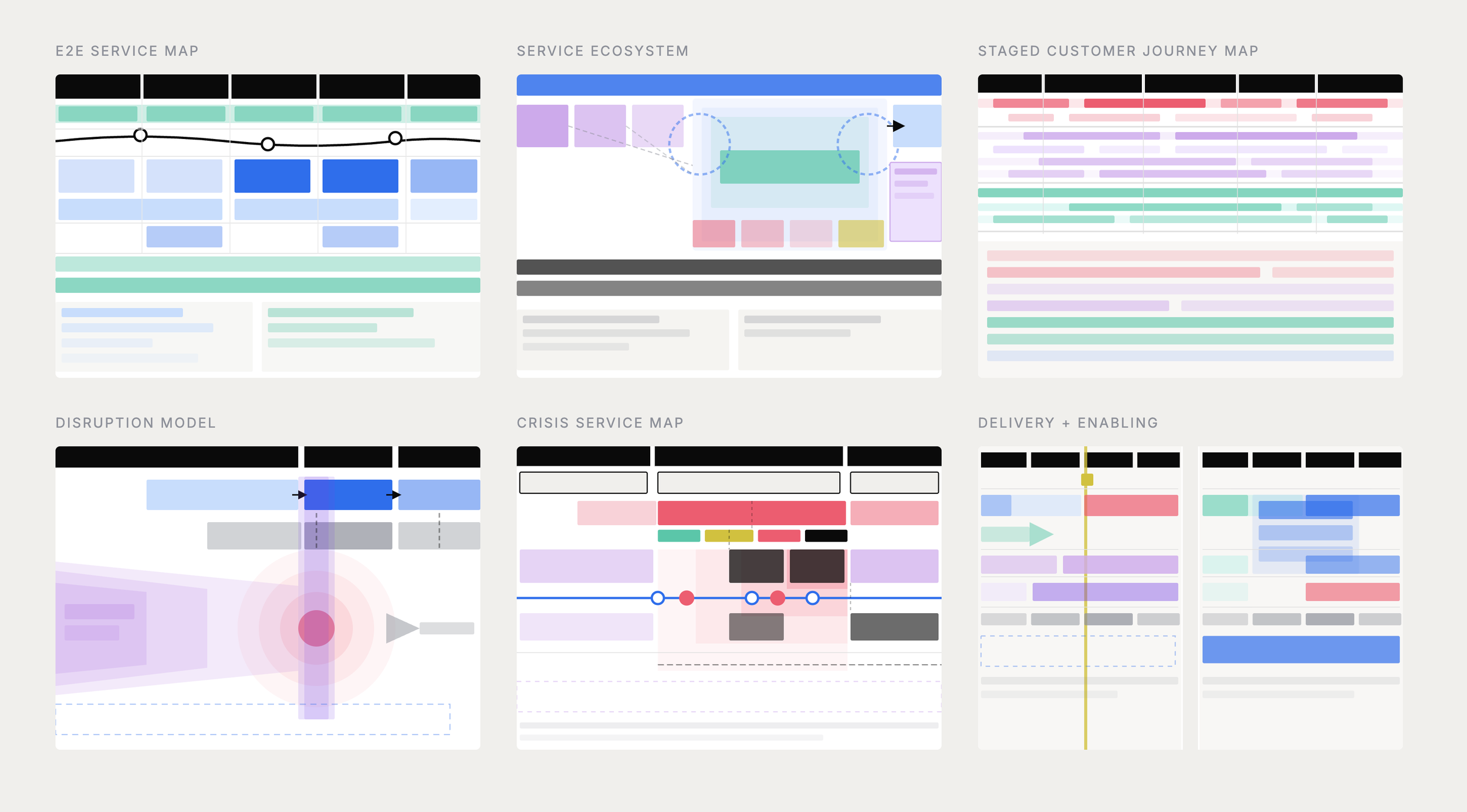
The service map isn't the point. The act of mapping together is. The learning, the disagreement, the decisions made in the room.
But the artefact matters too. A scrappy map is for working things out. A polished map is for communication and clarity. Maps should be living things. Evolve them. Rebuild when they get too messy. Keep going.
AI is starting to help here. I've been using it to think through operating models and customer experience architecture for clients. The core thinking still happened with the human team. I wouldn't outsource visual modelling, intuitive judgement, or context. But once the structure was there, AI helped tighten it. Faster and clearer than I'd have got there without it.
The tension: AI works well with an individual. It can't yet replicate a team building a service together. The shared sense-making. The moment someone draws it differently and everyone has to stop and think.
Richard Pope has been writing about this too. As AI reshapes how services are assembled, he argues the job becomes making things grippable - decisions, tasks, facts - concrete enough for people and machines to act on. The question is who holds the whole system together.
That's the thread. AI is making individuals faster, sharper, more capable. That's exciting.
But the hardest work in design has always happened between people. In the friction. In the reframing. In the build of shared understanding of what a product or service should be.
Right now, AI optimises for the individual. If we're not deliberate, we risk losing the co-design that makes the customer experience better.
The obvious answer is AI that works within teams. But I think the opportunity is bigger than that. What if AI became the connective tissue of a team, something that lives in the gaps between people. That carries memory across time: the decisions made, the reasoning behind them, the things tried and abandoned. And that holds the system as the team builds it, spotting conflicts and calling out gaps as the product or service develops.
AI amplifying what the team can build together. Anchoring what the team knows, joining up the gaps, and helping everyone find their way as the work evolves.
That's a hard problem. And one worth working on.